Observation and Atmosphere: J. M. W. Turner, Enlightenment Thought, and the Living Landscape
The Enlightenment period reshaped European art and literature by insisting on observation, inquiry, and the disciplined pursuit of knowledge as foundations for understanding the world. Within this intellectual climate, landscape ceased to function solely as backdrop or allegory and became a site of investigation, emotion, and philosophical reflection. The work of J. M. W. Turner stands as a critical bridge between Enlightenment rationalism and the later Romantic emphasis on sensation, perception, and the limits of human control. His practice remains central to how I understand landscape as an active, temporal force rather than a static image.
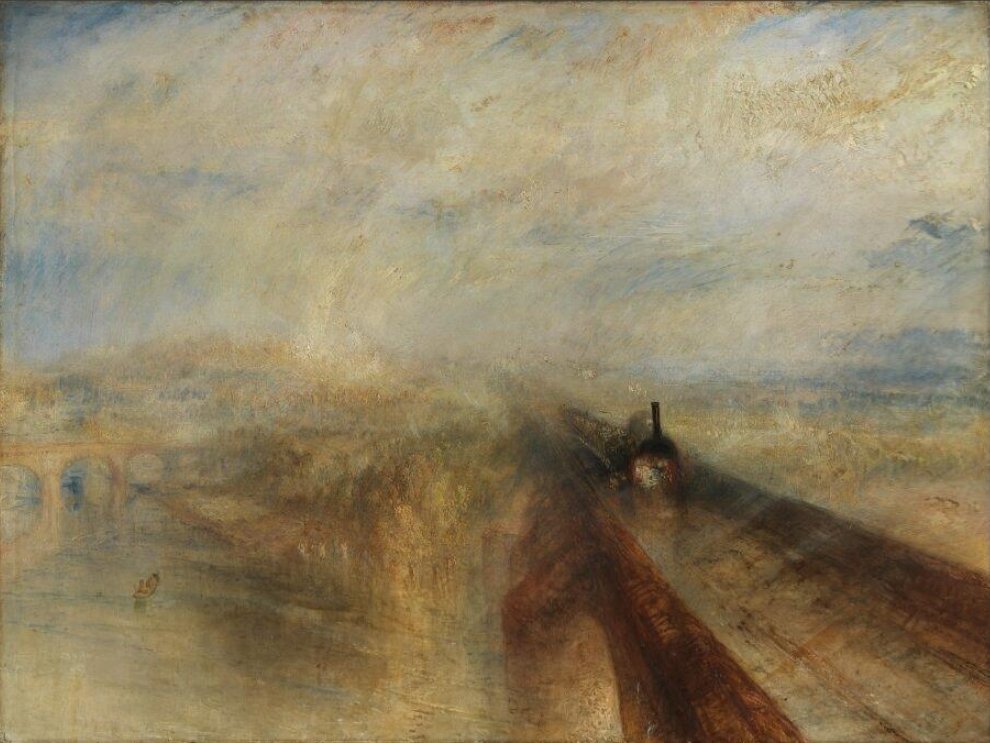
Rain, Steam, and Speed. J.M.W Turner, 1838. The National Gallery, London.
Turner emerged from an era shaped by scientific advancement, maritime expansion, and growing public engagement with natural philosophy. Enlightenment thinkers encouraged artists to study light, atmosphere, and material phenomena with rigor, and Turner absorbed this mandate deeply. His early work demonstrates close attention to topography, architecture, and weather systems, reflecting an empirical approach aligned with contemporaries such as John Constable. Yet Turner extended this inquiry beyond description. Observation became a means to interrogate instability, movement, and impermanence. In his mature works, form dissolves into light, vapor, and energy, revealing not a rejection of Enlightenment thought but its transformation. Reason gives way to perception, and certainty yields to experience.
This intellectual tension between order and dissolution is visible in Turner’s works held at the National Gallery, where paintings such as The Fighting Temeraire and Rain, Steam and Speed confront progress, memory, and velocity. These works present landscape as a field shaped by human ambition and natural force alike. Industrialization, maritime power, and technological acceleration are embedded within atmospheric structure rather than narrated explicitly. Turner’s method demonstrates how landscape can register historical pressure without resorting to literal documentation.
The foundations of Turner’s vision are inseparable from earlier European traditions preserved in major collections across the continent. At the Museo del Prado, the work of Diego Velázquez offers a parallel commitment to perception and restraint, particularly in the handling of light and spatial ambiguity. Velázquez’s economy of means and attentiveness to atmosphere informed Turner’s understanding of how paint can suggest presence rather than define form. Similarly, the classical landscapes of Claude Lorrain, studied extensively through works held at the Uffizi Gallery, provided Turner with a compositional framework rooted in balance and luminosity. Claude’s idealized vistas, grounded in Enlightenment ideals of harmony and reason, became a reference point from which Turner deliberately departed.
Literary thought of the period further shaped Turner’s sensibility and continues to inform my own practice. Edmund Burke’s inquiry into the sublime articulated an understanding of nature as overwhelming, destabilizing, and psychologically transformative. Johann Wolfgang von Goethe’s writings on color challenged purely mechanical explanations of vision, emphasizing perception as an embodied experience. These texts reframed landscape as a site where human understanding confronts its limits. Turner’s paintings operate within this intellectual space, treating light and color as forces that exceed rational containment.
The Vatican collections, now consolidated within the Vatican Museums, preserve earlier theological and philosophical frameworks that also resonate with Turner’s work. Renaissance and Baroque approaches to creation, order, and divine presence established a lineage in which nature is both structured and transcendent. Turner inherits this lineage while stripping it of narrative certainty, allowing atmosphere itself to carry spiritual weight.
This convergence of Enlightenment inquiry, Romantic perception, and historical continuity directly informs my approach to abstract cartography. Like Turner, I treat landscape as a living system shaped by time, pressure, and human presence. Observation remains foundational, but it is not employed to assert control or mastery. Instead, it serves as a method of listening to land as an active participant in meaning-making. Layering, erosion, and dissolution within my work echo Turner’s refusal to stabilize form, acknowledging that geography, like history, remains in flux.
The Enlightenment period offers a model of disciplined curiosity that continues to shape my practice. Its insistence on attention, study, and responsibility toward the natural world aligns with my belief that land carries memory and authority beyond human claims. Turner’s work demonstrates how painting can hold contradiction, combining structure with uncertainty and inquiry with reverence. In this lineage, landscape becomes not an object to be possessed but a record of encounter, where perception, history, and belief intersect and continue to unfold.
