Mapping the Sublime: Thomas Moran, Julius Haast, and the Nineteenth-Century Landscape
The nineteenth century produced a generation of artists and explorers whose work reshaped how landscape was understood culturally, scientifically, and politically. Among them, Thomas Moran and Julius Haast occupy a critical position. Their contributions extend beyond aesthetics, situating landscape as evidence, argument, and moral record at a moment when nations were actively defining themselves through land.
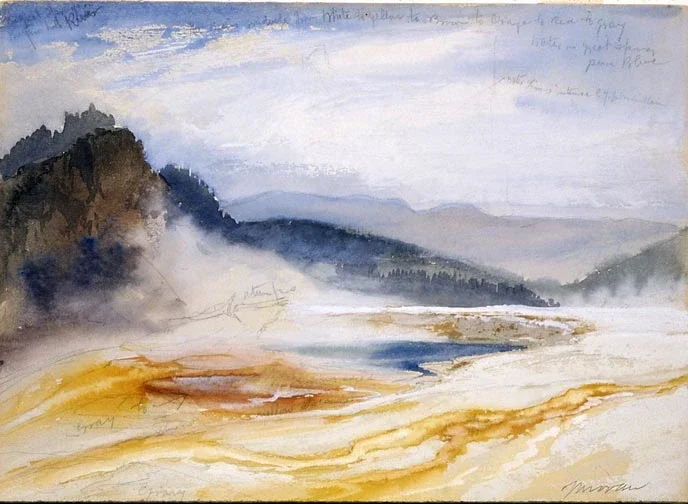
Great Springs of the Firehole River by Thomas Moran, 1871. NPS/YELL 8536.
Moran emerged within an American context shaped by westward expansion, scientific survey, and the desire to articulate a national identity distinct from Europe. His paintings of the American West were not conceived as neutral scenery but as persuasive instruments. Through scale, luminosity, and compositional authority, Moran presented wilderness as both sublime and significant. His work contributed directly to public policy, most notably through its influence on the establishment of Yellowstone as the first national park. Landscape, in Moran’s hands, became a civic force. As he recorded in his journals, “I place no value upon literal transcripts from Nature. My general scope is not realistic; all my tendencies are toward idealization.” This statement reveals an approach grounded in interpretation rather than transcription, where observation served higher conceptual and ethical aims.
Moran’s practice aligned with a broader nineteenth-century belief that land carried cultural and moral weight. His landscapes framed nature as something deserving preservation rather than extraction alone, shaping public imagination at a time when industrial expansion threatened irreparable loss. Paintings such as The Grand Canyon of the Yellowstone transformed geological phenomena into symbols of national inheritance, reinforcing the idea that landscape could define collective identity.
Julius Haast approached land from a different but complementary position. As a geologist, explorer, and advocate for scientific inquiry in New Zealand, Haast contributed to the mapping and understanding of terrain that was largely unknown to European science at the time. His surveys of the Southern Alps provided foundational geological knowledge, while his writings documented the intellectual responsibility of encountering unfamiliar land. Haast wrote, “Every mountain chain tells a history written in characters of stone,” framing geology as narrative rather than data alone. This perspective positioned land as an archive shaped by time, pressure, and movement.
Haast’s influence extended into cultural institutions through his role in establishing the Canterbury Museum, where scientific specimens were preserved not merely for study but for public education. His work contributed to the broader nineteenth-century project of cataloging the world, yet it also exposed the tension between scientific progress and colonial imposition. While Haast operated within imperial frameworks, his writings often expressed reverence for the land’s complexity and endurance beyond human intervention.
Other figures of the period reinforced this convergence of art, exploration, and inquiry. Painters such as Albert Bierstadt and Frederic Edwin Church, contemporaries of Moran within the Hudson River School, similarly framed landscape as expansive and consequential. Their works participated in shaping national consciousness while also advancing debates about preservation, progress, and spiritual encounter. Writers and thinkers of the era, influenced by natural philosophy and emerging environmental awareness, echoed these concerns. Landscape was no longer passive ground but an active participant in history.
What unites Moran, Haast, and their contemporaries is an understanding of land as formative rather than decorative. Their work insists that geography shapes belief, governance, and identity. Landscape becomes a site of encounter where observation carries ethical consequence. Journals and field notes from this period consistently emphasize attentiveness, patience, and humility before scale and time. Moran wrote of the American West that it possessed “a grandeur that dwarfs human ambition,” while Haast described alpine terrain as “a lesson in endurance beyond human measure.”
This lineage continues to inform contemporary approaches to landscape-based art. The nineteenth-century pioneer artists and explorers established a framework in which land is treated as a living system marked by history, movement, and consequence. Their practices demonstrate that to engage landscape seriously is to engage questions of power, stewardship, and belonging. By refusing to reduce land to surface alone, they expanded the role of art and science as parallel methods of inquiry.
Their legacy endures in how landscape is still mobilized within cultural discourse, environmental policy, and artistic practice. Moran and Haast did not simply record what they saw. They shaped how societies understood the relationship between people and place. In doing so, they established landscape as a record of encounter, responsibility, and continuity that extends far beyond the moment of observation.
