Sevilla Soul: Streets and Stories
Some cities are remembered through photographs. Others stay with us through sound, color, food, architecture, and the feeling of walking streets we may never walk in again.
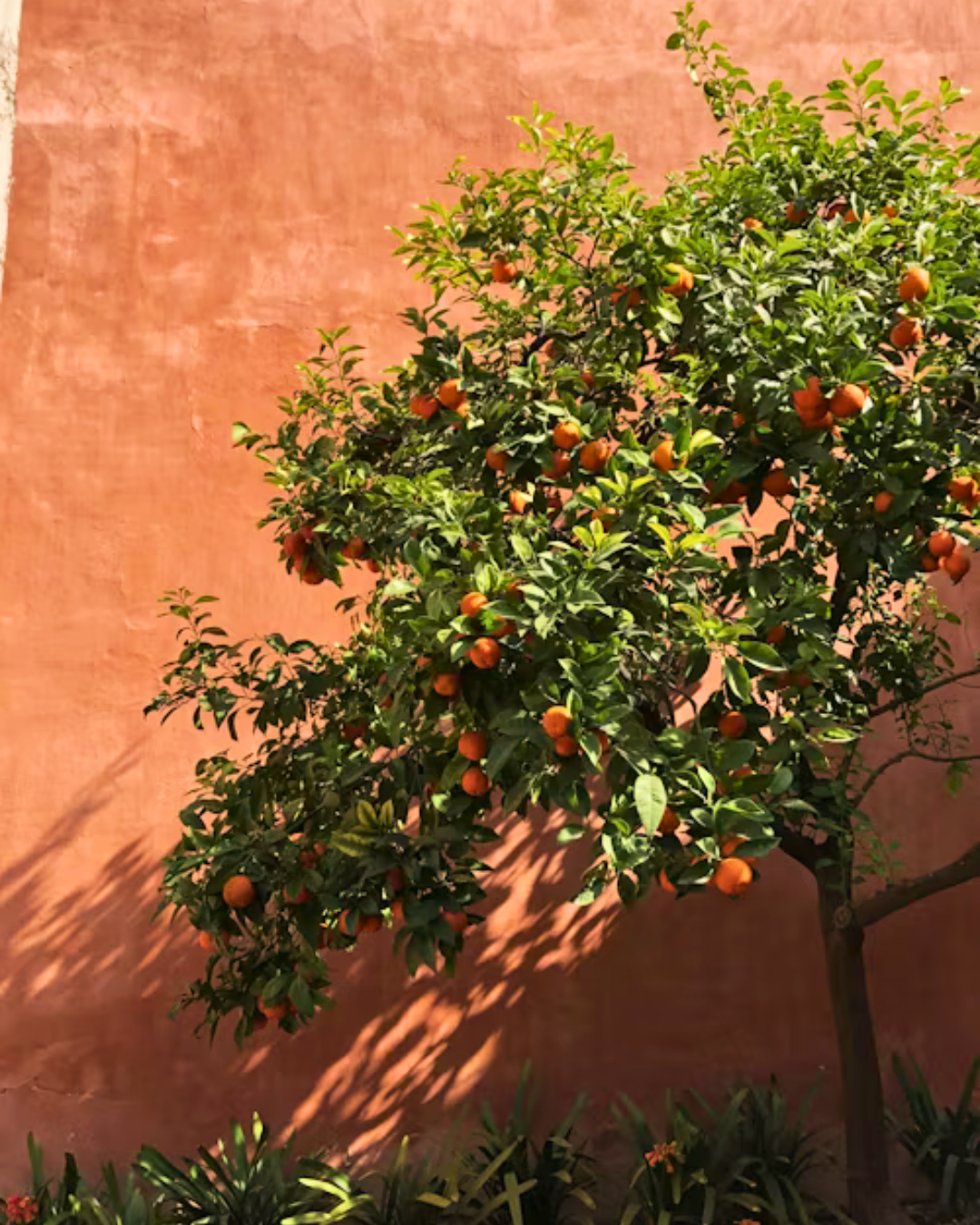
When I was commissioned to create this painting for a mother and daughter, I wanted it to feel like more than a map of where they had been. I wanted it to hold the atmosphere of Sevilla itself. The warmth of terracotta walls in the Spanish sun. Orange trees tucked into courtyards and lining city streets. The coolness of stone beneath your feet. The blue and white of painted ceramic tiles. Music drifting out of a doorway. The movement of flamenco. The Guadalquivir quietly dividing, and connecting, one part of the city to another.
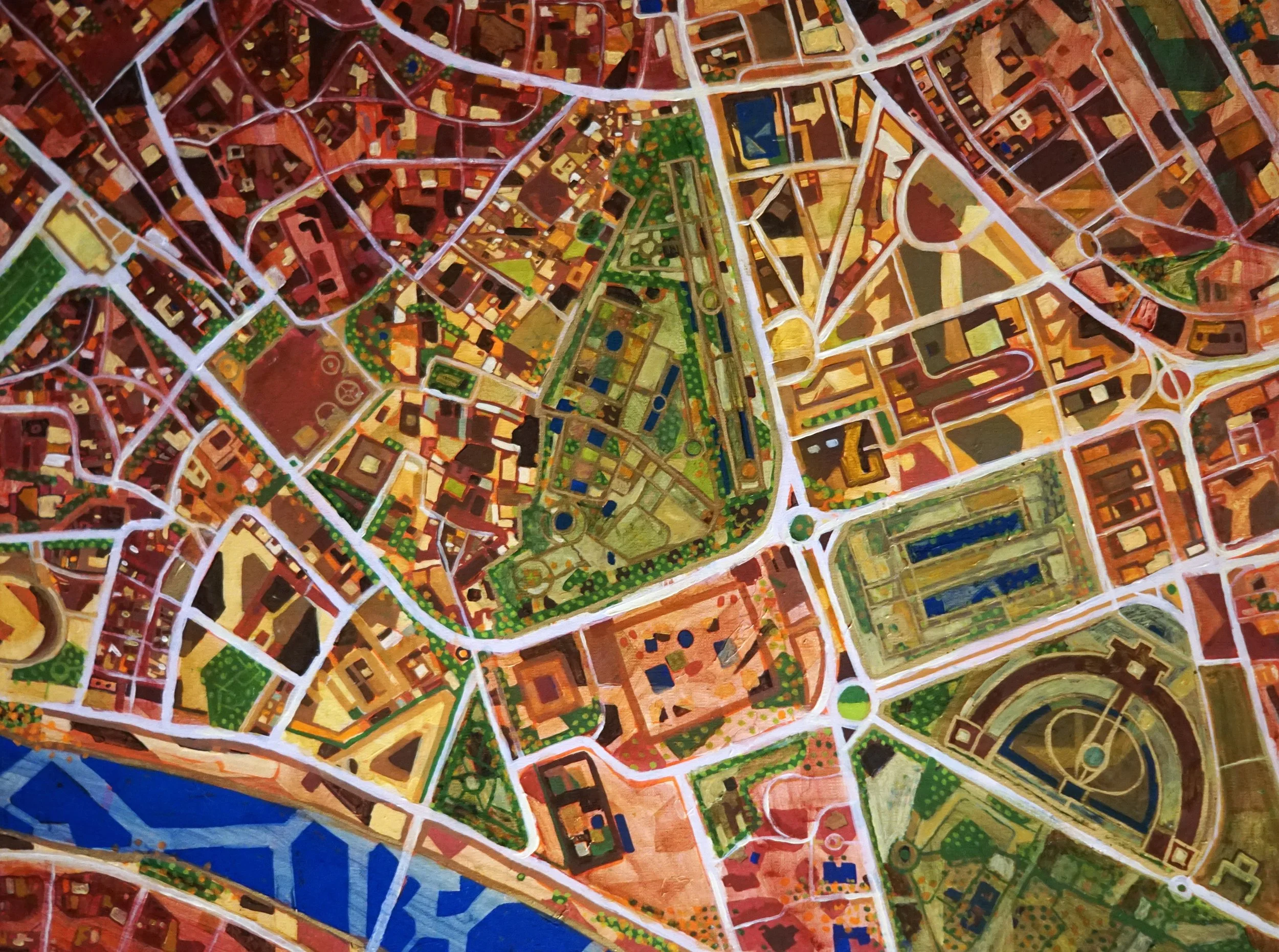
The result became Sevilla Soul: Streets & Stories, an abstract cartography painting built around the places, colors, and cultural details that give Sevilla its identity.
A City Built in Layers
To understand Sevilla is to understand that the city has never belonged to only one moment in history.
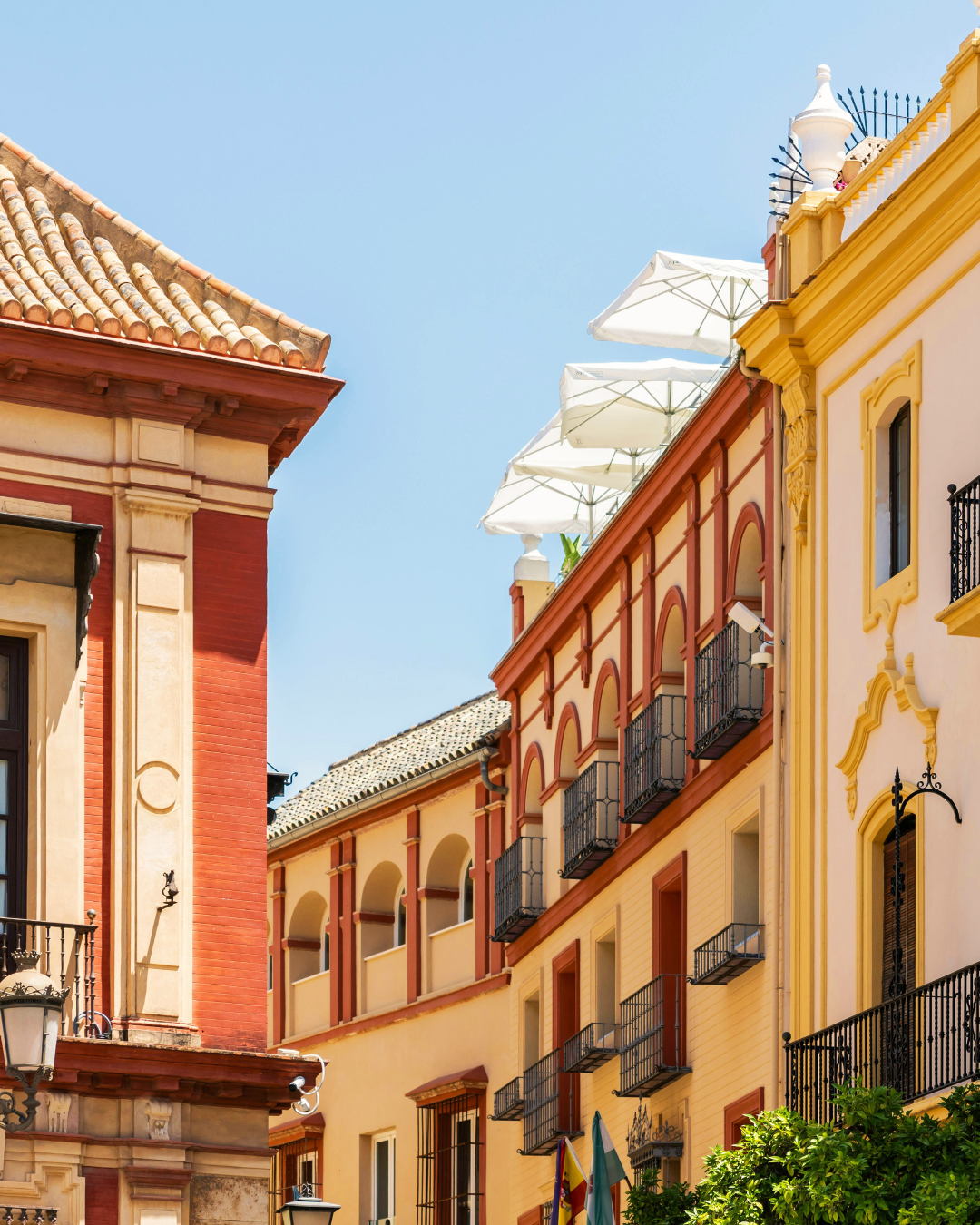
Roman, Islamic, Jewish, Christian, and later global influences have all left physical traces on the city. Architecture changes as you move through it. A minaret became a bell tower. Islamic palace architecture sits alongside later Gothic, Renaissance, and Baroque additions. Courtyards, gardens, ceramics, stonework, churches, palaces, and narrow streets reveal centuries layered closely together.
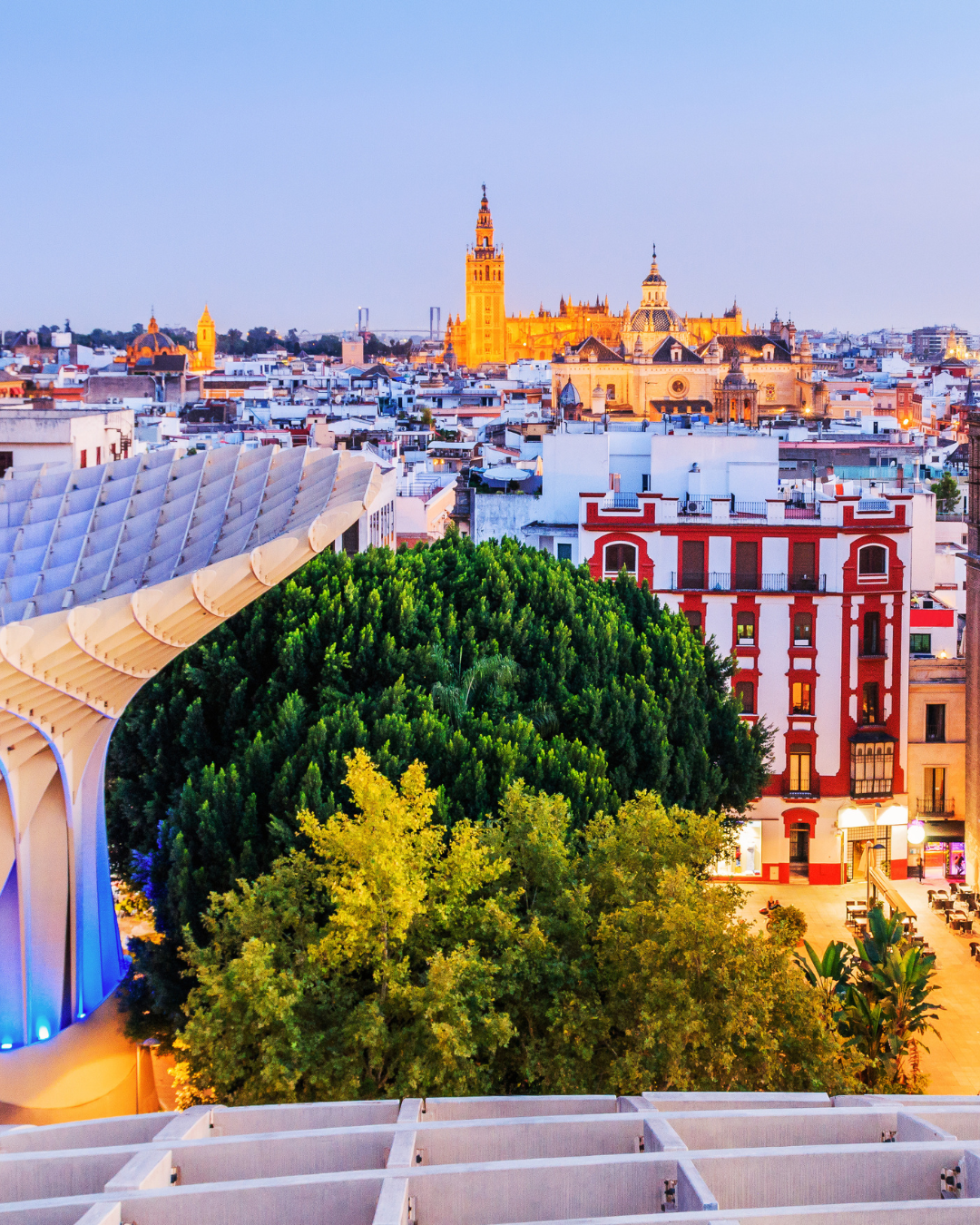
Few places illustrate this better than the Cathedral of Sevilla and the Giralda. The cathedral was founded on the site of the city's former main mosque, while the Giralda preserves the mosque's Almohad minaret beneath its later Renaissance additions. Nearby, the Royal Alcázar carries its own remarkable collection of architectural histories, including Islamic, Mudéjar, Gothic, Renaissance, and later influences. Together with the Archivo de Indias, the Cathedral and Alcázar have been recognized as a UNESCO World Heritage Site since 1987.
Rather than simplifying Sevilla into clean blocks of color, I allowed neighborhoods, buildings, streets, gardens, and landmarks to gather densely across the canvas. From a distance, you see a city. As you move closer, individual marks begin to emerge. Tiny shapes become buildings. Green spaces appear between streets. Architectural forms begin to distinguish themselves.
The experience is similar to discovering a city on foot. You rarely understand everything at once. You understand it one street at a time.
Following the Streets
At the heart of the painting is the Royal Alcázar of Sevilla, surrounded by gardens and the dense network of the historic center. Its origins reach back to the 10th century, and generations of rulers continued to build and reshape the complex. The result is a palace where different periods coexist rather than replace one another.
Nearby rises the Cathedral of Sevilla, with the Giralda carrying the memory of the mosque that stood before it. The cathedral itself grew into the largest Gothic building in Europe.
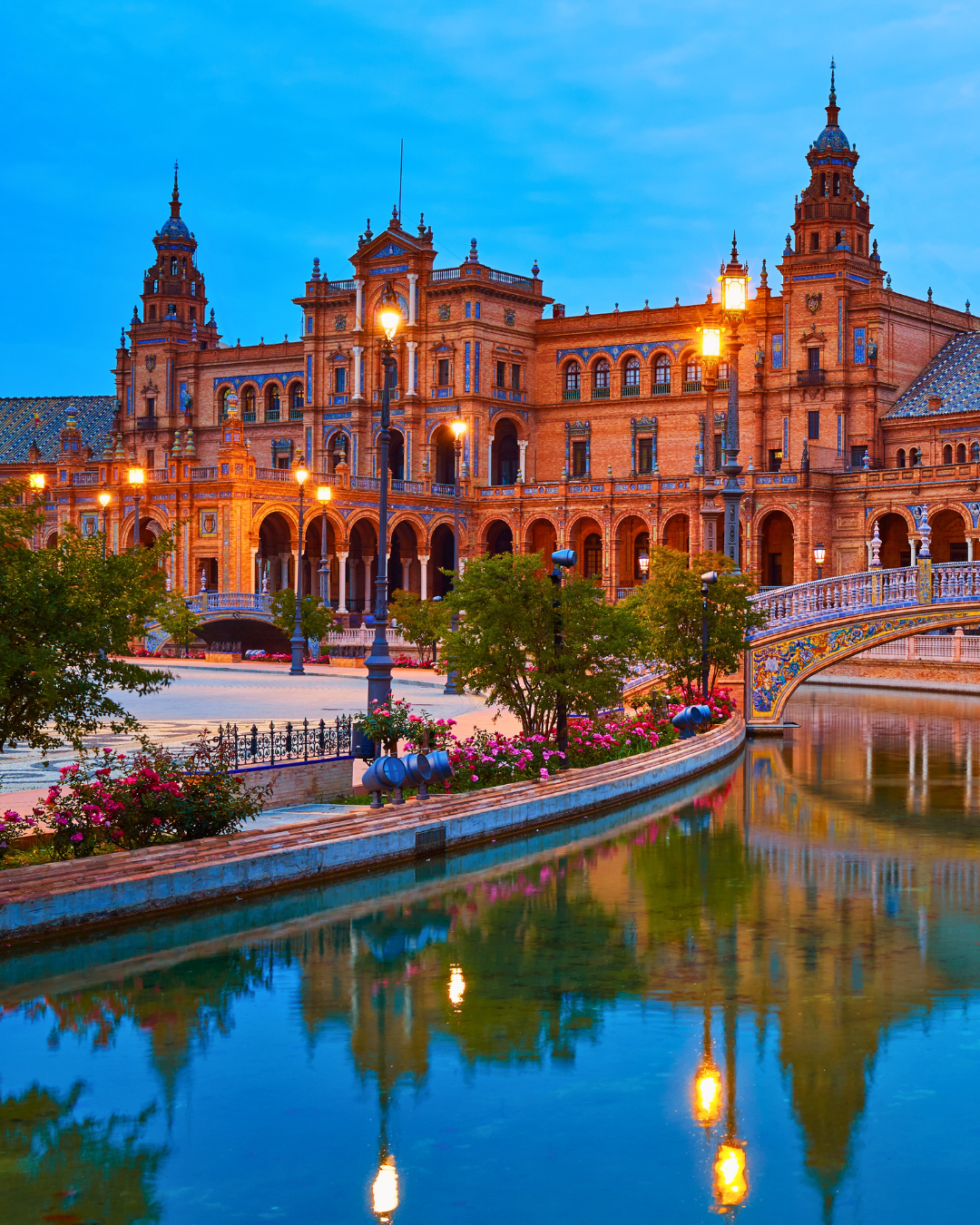
Travel farther through the painting and the city begins opening toward another unmistakable landmark, the Plaza de España. Built for the Ibero-American Exposition of 1929 and designed by Sevillian architect Aníbal González, the sweeping semicircular plaza combines architecture, water, bridges, ceramics, and ornament into one enormous composition. Its tiled alcoves represent the provinces of Spain, while four bridges cross its canal.
Those ceramics became especially important to my interpretation of this commission. The sides of the painting continue beyond the map itself with replicas inspired by the cobalt blue and white tiles of Plaza de España. Instead of treating the edges of the canvas as a stopping point, I wanted them to become part of the journey. Sevilla's ceramic tradition is woven throughout the city, particularly in places such as Plaza de España, the Alcázar, and Triana.
Across the Guadalquivir
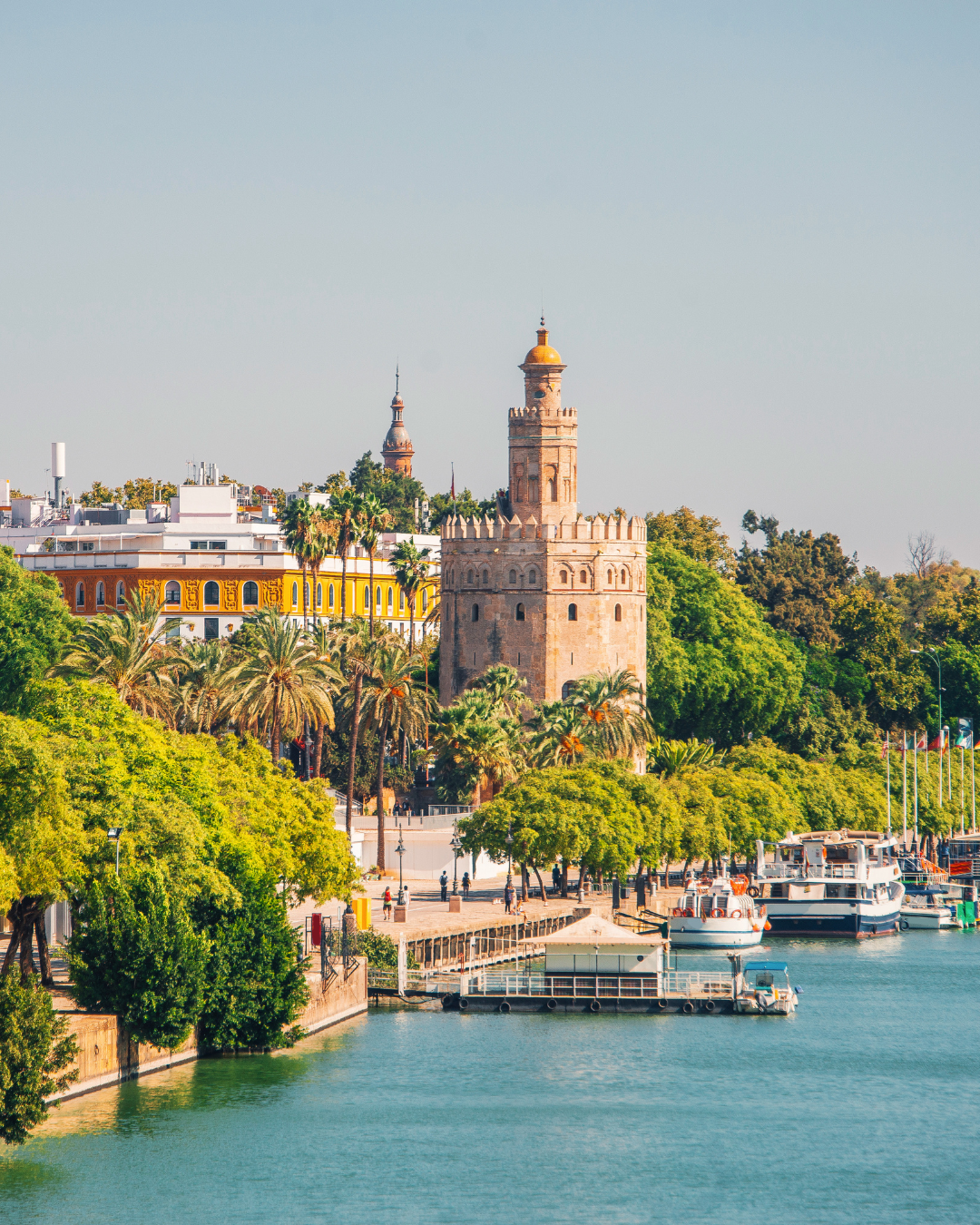
Eventually, the streets lead toward the Guadalquivir River and the Triana Bridge. Officially called the Isabel II Bridge, it was completed in 1852 and became Sevilla's first permanent metal bridge. Before it existed, people crossed between Sevilla and Triana using a bridge of boats near the same location.
There is something fitting about including a bridge in a painting created for a mother and daughter.
A bridge is a connection between two places. A shared journey does something similar between two people. Years later, the details of a trip may soften. Restaurants close. Streets change. Photographs disappear into camera rolls. The experience itself becomes part of the relationship.
Across that bridge lies Triana, a neighborhood deeply associated with Sevilla's ceramic traditions and cultural life. Its history of craftsmanship is visible in the tiles decorating patios, façades, churches, shops, and streets. It is also impossible to think about Sevilla without thinking about flamenco. The city carries rhythm everywhere. Guitar. Singing. Handclaps. Footwork. Dresses moving through space. Flamenco feels at home here because Sevilla itself seems built around rhythm. Streets tighten and open. Courtyards interrupt buildings. Church bells mark time overhead. People gather late into the evening. Music and dance become another kind of map, one made through the movement and rhythm of the paintbrush.
How the Painting Came Together
The painting began beneath the city itself. Before I mapped a single street or landmark, I started with Moorish-inspired tilework, drawing from the geometric patterns that appear throughout Sevilla. These patterns speak to the centuries of Islamic influence that remain visible in the city's architecture, courtyards, palaces, and decorative arts. I wanted that history to exist as the foundation of the painting, much like it exists beneath the Sevilla we experience today.
From there, I began building the city in layers. City blocks emerged first, creating the larger structure of Sevilla, followed by streets that began cutting through them and connecting one neighborhood to another. Then came the smaller details: individual buildings, courtyards, gardens, plazas, trees, pathways, and architectural forms. With each new layer, the city became denser and more intricate. The process became a reflection of Sevilla itself. Beneath the surface of the modern city is the depth of its history—Roman foundations, Moorish architecture, Christian cathedrals, royal palaces, ceramic traditions, gardens, music, dance, and generations of everyday life have accumulated within the same streets. I wanted the painting to carry that same sense of time, allowing earlier layers to remain present even as they were partially covered by what came next.
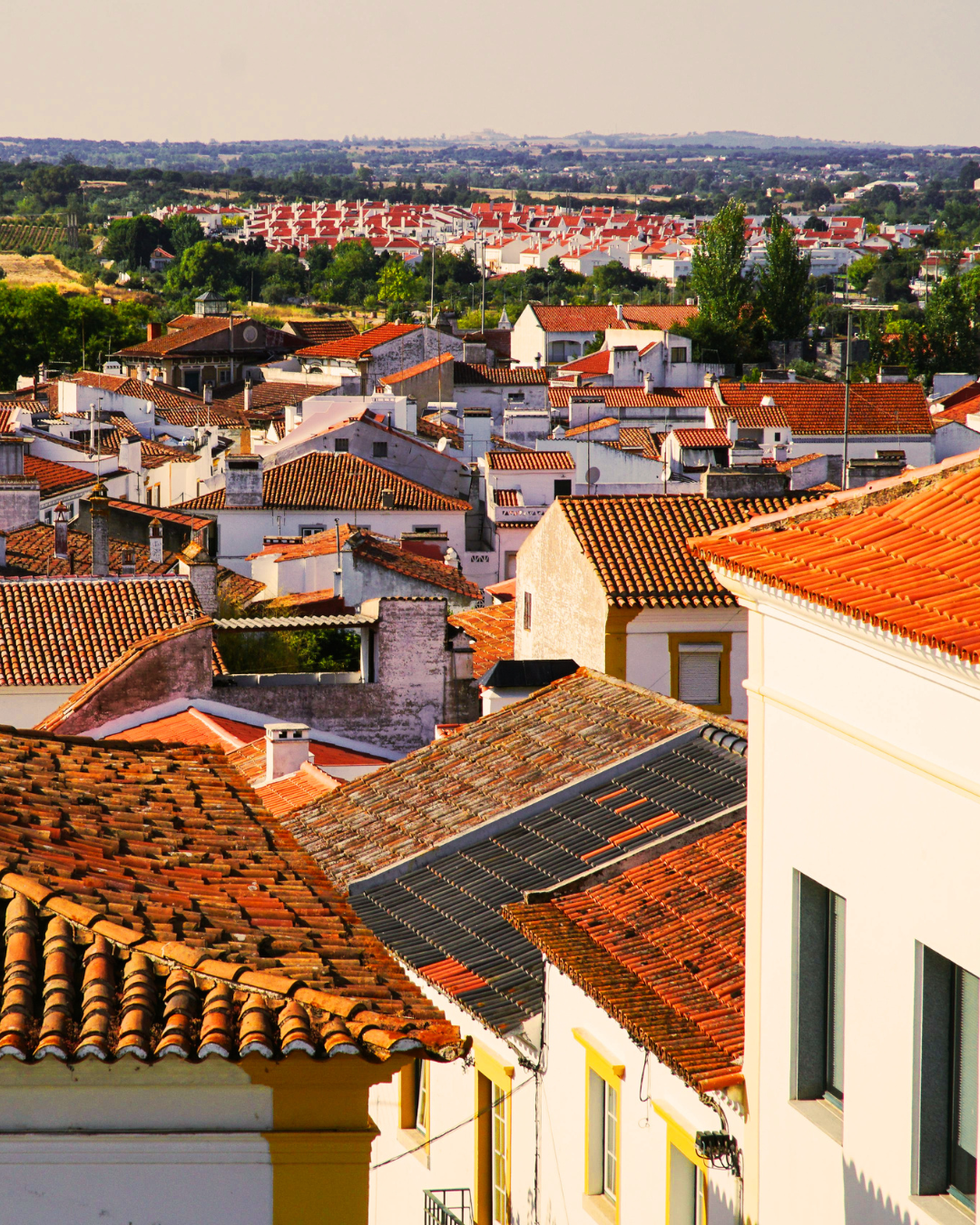
I wanted the palette to feel as though it could have been gathered while walking through the city. Terracotta became the foundation, drawn from rooftops, façades, ceramics, and sun-warmed architecture. Orange came from Sevilla's orange trees, whose fruit and blossoms are inseparable from the sensory memory of the city. Shades of green move through the painting like gardens hidden behind walls, referencing the Alcázar gardens, parks, courtyards, palms, and the pockets of vegetation that soften Sevilla's dense architecture. Stone provides a quieter counterpoint, belonging to plazas, monuments, churches, streets, and the architecture that has endured while generations have passed through it. Then there is cobalt blue. Against all that warmth, the blue carries the decorative language of Sevilla's ceramics and the unmistakable tilework of Plaza de España. It creates a visual pause within the warmer palette, much like the Guadalquivir creates space within the city. Together, these colors create something closer to memory than topography. They are less about reproducing the literal colors of a map and more about remembering what Sevilla feels like.
Once the city began to take shape, its landmarks became points of orientation within all of that detail. Plaza de España, Plaza de Toros, the Cathedral of Sevilla, the Royal Alcázar, and the Triana Bridge were carefully drawn into the surrounding city and highlighted with gold leaf. The gold changes as the light changes. From one angle, a landmark settles quietly into the surrounding streets; from another, it catches the light and emerges from the city. I wanted these places to be discovered slowly, in much the same way landmarks reveal themselves while wandering through an unfamiliar place.
Finally, the edges of the canvas return to where the painting began: tilework. The sides are painted as replicas inspired by the cobalt blue and white ceramic tiles of Plaza de España, allowing Sevilla's visual language to continue beyond the face of the map. Building the painting this way felt appropriate for a city shaped by layers. At first glance, you see Sevilla. Come closer and you begin to find its streets, gardens, buildings, landmarks, patterns, and small details. Look deeper still, and there is another story beneath them.
A Map for Two
Sevilla Soul: Streets & Stories becomes especially meaningful as it was created as a commission for a mother and daughter. Traveling with someone creates a private geography. There are the landmarks that appear on every map—the places everyone photographs and the streets everyone walks—but there are also the places that become yours. The corner where you stopped because you were tired, the meal you still talk about, the unexpected view that made you pause, the joke that only makes sense to the two of you, the sound of a plaza at night, or the route you found yourself walking again and again. There is the moment when you suddenly realize that you are going to remember this trip for a very long time.
None of those experiences appear on a conventional map, yet they are just as much a part of a place's geography. They are the invisible landmarks we carry home with us—the moments that transform a destination from somewhere we visited into somewhere that belongs to our story. That is what I wanted this painting to hold.
Sevilla Soul: Streets & Stories is a portrait of a city shaped through terracotta and stone, orange trees and gardens, cobalt ceramics and winding streets. It carries the Cathedral, the Alcázar, Plaza de España, Plaza de Toros, the Guadalquivir, and the bridge into Triana. It carries traces of architecture, craftsmanship, music, dance, and the many cultures that have shaped Sevilla over centuries. But beneath all of those visible layers is something more personal: the memory of two people experiencing this extraordinary place together.
In the end, this painting is not simply a map of Sevilla. It is a map of what Sevilla meant to them. It is a way of preserving the streets they walked, the places they discovered, and the memories they created together. Long after a journey ends, a place can remain part of us. We carry its colors, its sounds, its textures, and its stories forward, sometimes without even realizing it. And sometimes, all it takes is a map to find our way back.
Your Place. Your Story. Your Map.
The places we love become more than locations. They become the meals we shared, the streets we wandered, the people we traveled with, and the moments we never want to forget.
Commission a custom map painting of a place that holds meaning for you. Together, we'll transform your memories, landmarks, and personal stories into an original work of art—a map of not only where you went, but what that place meant to you.
Let's create your map.
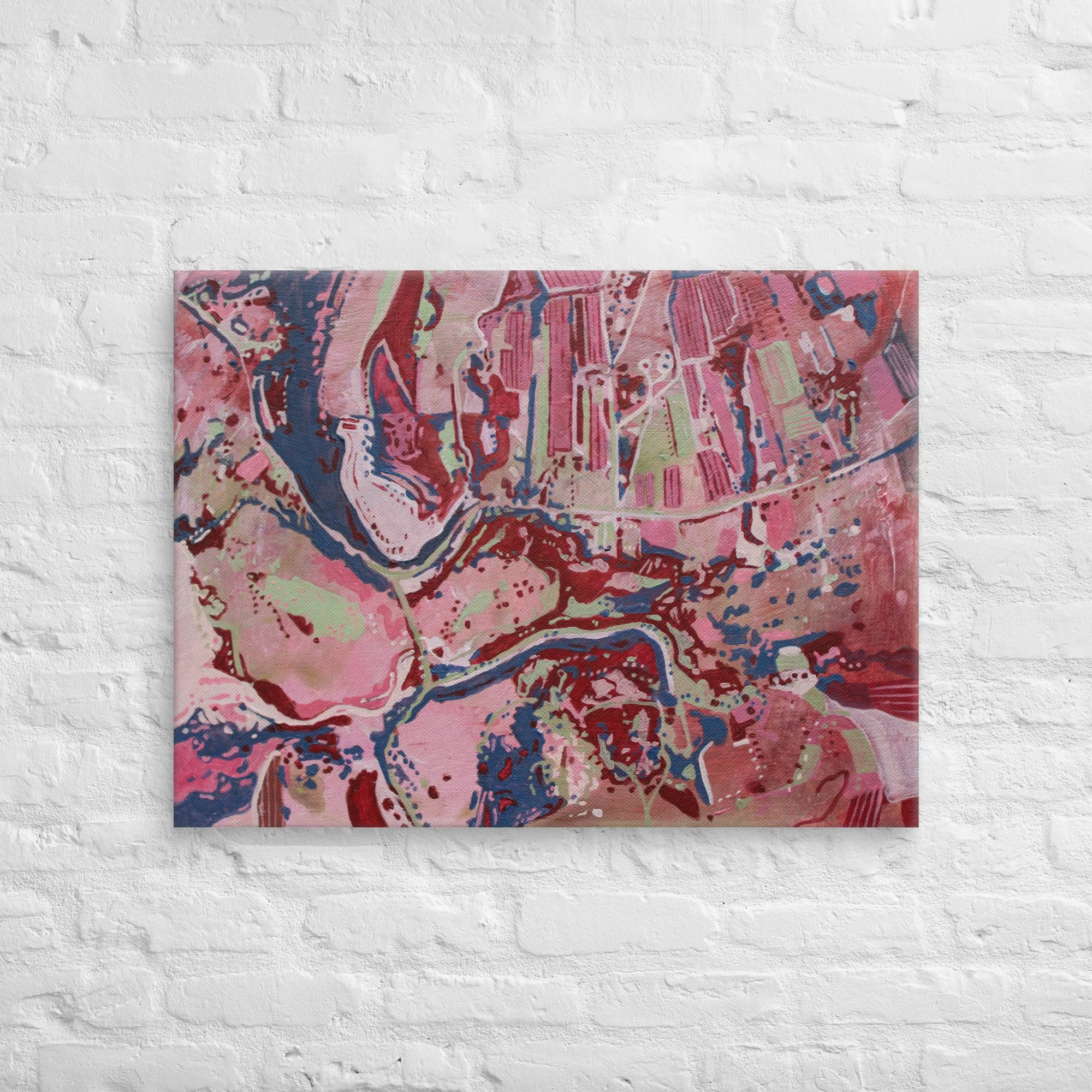
Commission an original painting of a place that has become part of your life.
Personal Cartography transforms meaningful geography into abstract, map-inspired artwork. A childhood neighborhood. The city where you met. A coastline returned to each summer. A honeymoon destination. A family property. A route traveled repeatedly. Or several places connected across years.
Each commission begins with the geography itself, then moves beyond the map. I research the location and consider its roads, waterways, boundaries, architecture, landscape, history, and other details that give the place its character. Through color, texture, line, and abstraction, that geography becomes something personal.
The finished painting is not intended to reproduce a conventional map. It is an interpretation of where your life unfolded and what remains of that place in memory.
Materials
Choose from:
Archival Oil Paper: An intimate, heavyweight oil-painting surface intended for professional framing.
Archival ACM Panel: A smooth, rigid and highly stable surface with a contemporary presentation.
Oil-Primed Linen: A traditional fine-art surface with subtle texture, particularly suited to expressive brushwork.
Birchwood Panel: A substantial rigid surface with a warm, tactile character.
Oil or acrylic paint is selected according to the surface and desired character of the painting. Available materials vary by size.
Sizes
Small: 9" × 12" to 11" × 14"
An intimate study of one meaningful place. Ideal for a neighborhood, property, coastline, landmark, or destinatio.
Medium: 12" × 18" to 18" × 24"
Offers more room for geographic detail, interconnected landmarks, waterways, roads, and the character of the surrounding landscape.
Large: 24" × 30" to 30" × 40"
Designed for more expansive compositions, complex geography, multiple connected locations, or a place explored through greater depth and detail.
Gallery: 36" × 36"+
Large-scale statement works created for significant personal narratives, expansive geography, and residential, hospitality, or commercial spaces.
Pricing & Consultation
The listed price reflects a 50% deposit toward your commission. Final pricing is based on the selected size, material, and composition and will be confirmed during your consultation before the commission agreement is signed.
Multiple subjects, complex settings, extensive detail, specialty materials, or significant reconstruction from several photographs may require an additional fee.
Any adjustment is discussed and approved before your commission agreement is signed and before painting begins. You may approve the revised price, adjust the concept to remain within your original budget, or request a refund before signing the agreement.
How It Works
1. Reserve — Select your size, material, and payment option.
2. Share — Send several high-resolution photographs and tell me about the people and moment you would like preserved.
3. Consult — Within 24–48 hours, I will reach out to begin the collaboration process. We will discuss setting, color, atmosphere, materials, and meaningful details.
4. Approve — I’ll confirm the final scope, price, and timeline. Your commission begins after the agreement is signed.
5. Create — Your cartography is painted individually by hand, with progress images shared at key stages.
6. Deliver — Once complete and sufficiently cured, your painting is carefully prepared for delivery.
Timeline
Allow approximately 10–12 weeks from signing the commission agreement, including approximately 10–12 weeks for painting and 2–8 business days for shipping.
Oil paintings may require additional drying time. Larger or more complex commissions may require longer. For weddings, anniversaries, holidays, or other time-sensitive gifts, please reserve early.
Photography
Clients are responsible for providing photographs they own or have permission to use. Professional wedding, engagement, or newborn photography may require permission from the photographer.
Shipping
Small and medium works are generally shipped flat and protected. Large works may require custom crating, freight, white-glove delivery, or installation. Additional delivery costs are quoted when applicable.
Commission Policy
Because each landscape is made specifically for you, commissions cannot be returned or exchanged once the agreement has been signed and painting has begun.
Before signing, you may adjust the scope, approve any price adjustment, or request a refund.
Reserve Your Personal Cartography
Some places become more than coordinates on a map. They hold the roads we traveled, the landscapes we remember, and the moments that unfolded there. A Personal Cartography commission transforms that geography into an original work of art, preserving a place that has become part of your story.
Frame not included. Shipping, specialty crating, and installation may be quoted separately when applicable.
