Inside the Studio: A Creative Interview with Artist Christina Leigh
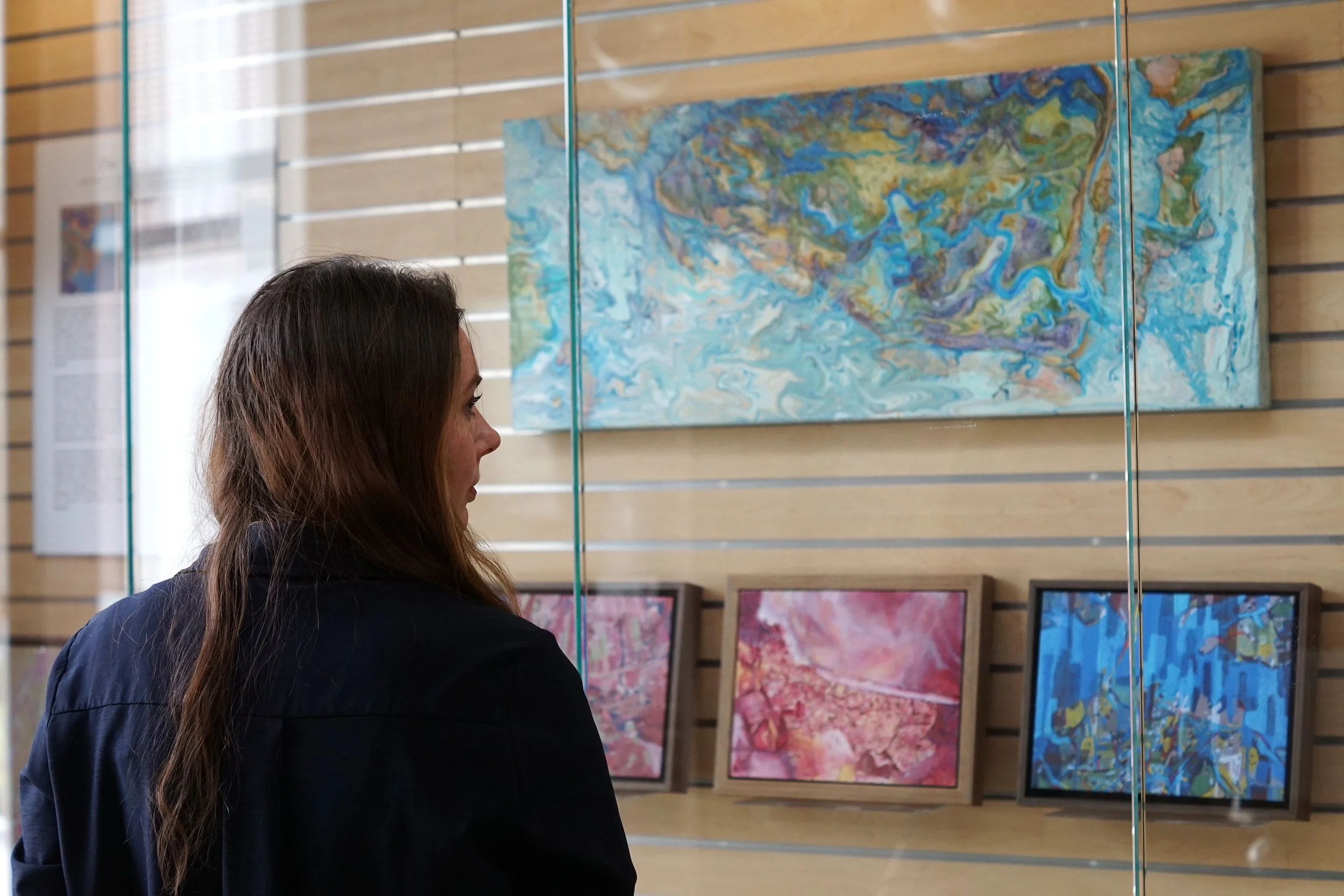
Christina Leigh viewing her exhibition “The Places We Carry'‘ at Georgia Southern, Armstrong Campus, Savannah, GA.
“The past accumulates like impasto, one moment painted over by another.”
For Christina Leigh, geography is never simply geography. A coastline can hold the memory of an arrival. A road can mark a chapter of a life. A city grid can contain centuries of planning, movement, commerce, loss, celebration, and change.
As the artist behind CLR Creations, Christina creates contemporary abstract cartography, paintings rooted in real locations but shaped by research, observation, travel, history, and lived experience. Her practice has carried her from the mountains of the American West to the vineyards of Aotearoa New Zealand, the streets of Spain, and the tidal landscapes of coastal Georgia. Now working in Savannah, she is increasingly interested in what exists beneath the familiar map: the histories, ecosystems, cultures, people, and experiences that give geography meaning.
In this interview, Christina talks about curiosity, faith, creative rituals, the tradition of landscape painting, and the surprisingly difficult question of knowing when a painting is finished.
Tell us about yourself.
I have always been curious about place. I’m an artist, traveler, researcher, and observer. I studied Studio Art and Graphic Design, but my life after art school also took me through hospitality, tourism, marketing, museums, teaching, and years of moving through different landscapes. For a long time, I thought those were separate chapters. Now I understand that they were teaching me how to make and speak about my work today.
Hospitality taught me to think about how people experience a destination. Travel taught me to observe. Museums taught me to ask questions. Living in different places taught me how deeply geography becomes intertwined with our personal lives. My paintings bring those experiences together.
I begin with actual geography, including roads, waterways, boundaries, topography, and architecture, but I’m less interested in reproducing a map than in asking what a map cannot show. Who lived here? What happened here? What disappeared? What do we remember? What do we leave behind, and what do we carry with us when we go?
What are you most proud of in your art?
I’m proud that I returned to painting. It is at the core of who I am. There were years when painting wasn’t at the center of my professional life. I was building a career, traveling, working in hospitality and tourism, studying, teaching, and moving from one place to another. But I never stopped looking, and I never stopped learning.
New Zealand became an important turning point. The paintings that emerged from that experience helped me recognize that everything I had been doing, traveling, researching, studying landscapes, talking with people, and learning about destinations, could belong within my artistic practice. I didn’t have to separate the artist from the rest of my life.
I’m also proud that I’m developing a visual language that increasingly feels like my own. Grids, waterways, boundaries, topographic forms, repeated marks, scraping, negative space, and fragments of recognizable geography have become ways of speaking about something much larger than mapping a location.
What are you most proud of in life?
Continuing to be curious. My life has not followed one clean line. There have been different careers, different landscapes, different ambitions, and plenty of unexpected turns. I’ve learned that experience never goes to waste. Something I encountered years ago can unexpectedly find its way into a painting today.
I’m proud that I continue to learn, travel, ask questions, serve my community, and make room for creativity even when life becomes complicated. Curiosity keeps me moving forward.
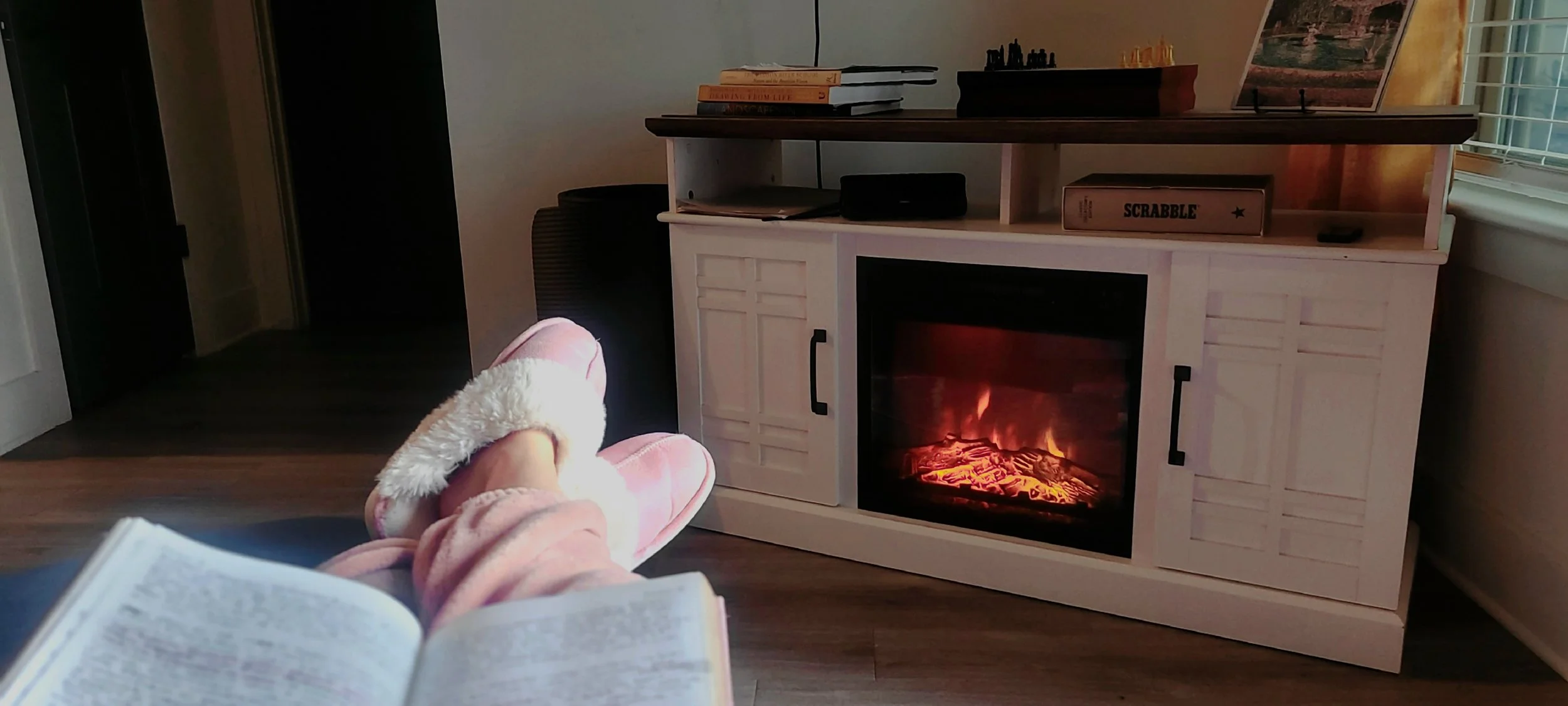
Christina Leigh journaling in the morning in her living room, before she enters the studio.
Do you have any studio rituals that help you enter a creative flow?
My creative ritual usually begins before I enter the studio. I start my morning with prayer and meditation. My faith shapes how I understand creativity. I see myself as a vessel for the Lord’s creative work rather than its sole origin. I’m also a writer, so I spend time journaling and allowing ideas to develop without immediately trying to organize them.
When a new project begins, that openness becomes research. I start with questions and follow them wherever they lead. That might mean reading academic papers, studying archival materials, exploring museums, meeting with historians or other experts, walking a landscape, or simply sitting somewhere and observing it in real time.
I pay attention to conversations and small details that may initially seem unrelated to painting, such as the direction of water, the texture of a wall, a fragment of local history, or the way people move through a public space. By the time I begin painting, I have accumulated a collection of information, observations, and impressions.
But research is only the beginning. Eventually, I have to release some control and allow the painting to become its own object. I work through repetition and interruption using lines, grids, marks, texture, opacity, scraping, removal, and areas where I intentionally leave the surface alone. Some of my favorite moments occur when something carefully constructed is partially destroyed. Often, that makes the painting feel more truthful.
Places behave similarly. They accumulate. They erode. They are rebuilt. Buildings disappear. Landscapes are altered. Something once considered important can be removed to make way for development.
How do you structure your day?
I balance studio work with the practical responsibilities of maintaining an art practice, including research, writing, documentation, exhibitions, applications, marketing, correspondence, and all of the administrative work that happens beyond the canvas.
I try to protect longer periods for painting because it takes time to move beyond the conscious beginning of a studio session. At first, I may be mixing paint, studying references, evaluating composition, or looking at the relationships between color and value. Eventually, I want to reach the point where instinct begins to take over.
I also leave the studio intentionally. Walking, traveling, visiting museums, exploring Savannah, researching a site, or simply paying attention to ordinary surroundings are all part of the practice. Not all studio time happens in the studio.
Where do you find inspiration for your art?
Places, but not simply beautiful ones. I’m interested in the stories a destination holds, and sometimes those stories are complicated or uncomfortable. A tidal creek cutting through marsh grass. Vineyard rows following a hillside. Railroad tracks dividing a city. A historic street grid. Oyster shells beneath an island. Architecture altered by generations of use.
Sometimes inspiration begins with awe. Other times it begins by being present long enough to recognize that inspiration can live inside a question.
Savannah has become particularly rich territory for me because the visible city sits over so much history. You can stand in a square and see live oaks, brick, architecture, tourists, children playing, and people eating lunch. Then you begin researching that same ground and discover earlier markets, demolished buildings, political decisions, commerce, migration, celebration, injustice, and generations of ordinary lives.
The familiar landscape becomes much more complicated. That complexity interests me.
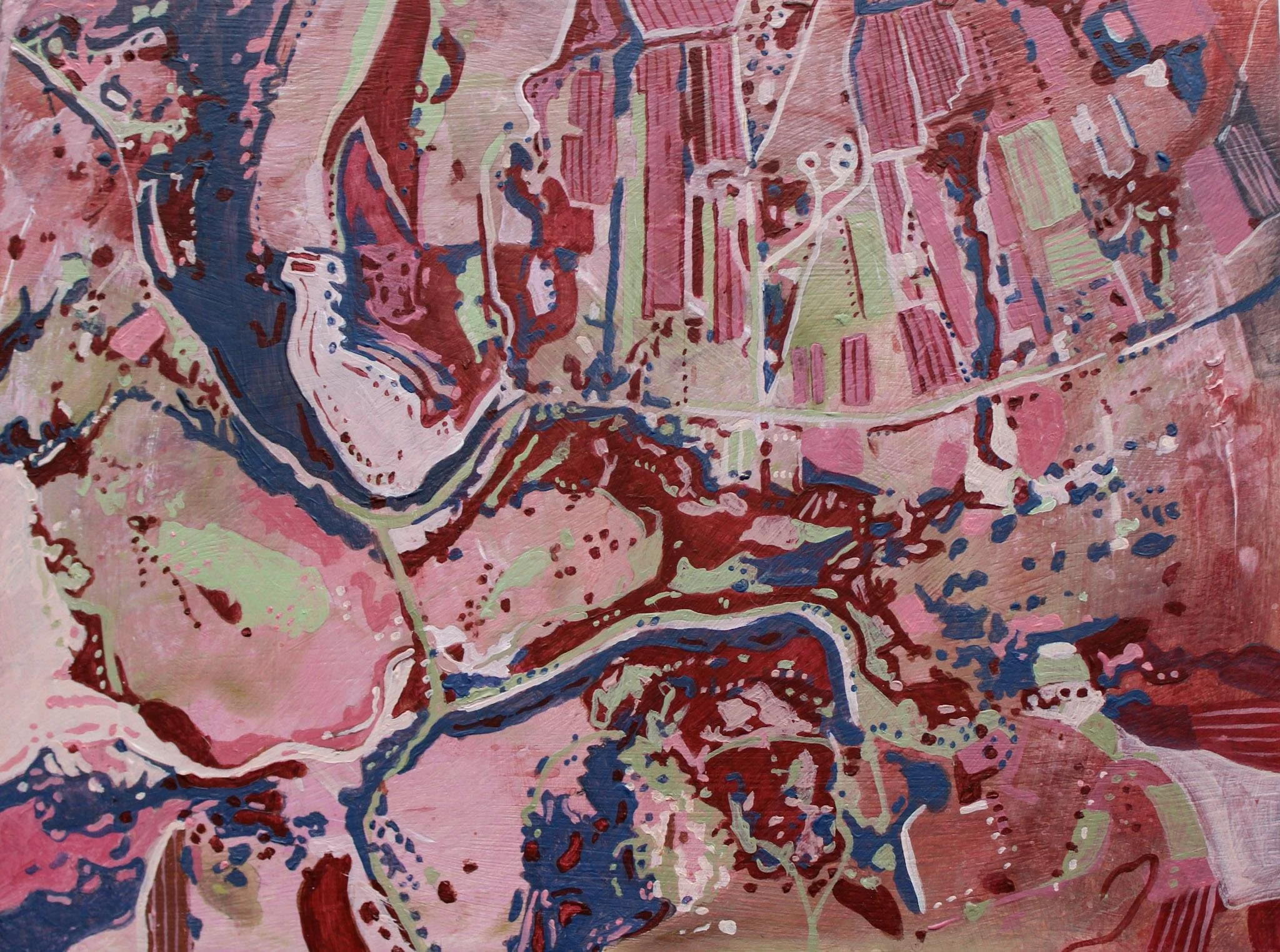
“Tantalus” by Christina Leigh featuring the colors, smells, and tastes of Syrah from Tantalus Estates, Waiheke Island, New Zealand.
Tell us about your evolution as an artist.
My formal arts education began at a conservatory-style high school, where I developed a foundation in drawing, painting, composition, color, design, art history, and visual analysis. Even then, I was interested in the intellectual traditions surrounding landscape, particularly Romanticism and Transcendentalism, as well as the Enlightenment-era impulse to observe, document, classify, and understand the natural world.
Artists such as J.M.W. Turner, Thomas Moran, and Julius von Haast have influenced how I think about the relationship between art, exploration, landscape, and knowledge. What fascinates me is that landscape imagery has never been merely aesthetic. Images of land have helped shape cultural imagination, scientific understanding, political narratives, and ideas about national identity. Landscape can operate as beauty, evidence, argument, memory, and record.
I began exploring those ideas during my senior year of high school, long before I had the language of abstract cartography to describe where the work might eventually lead. Over time, I became less interested in painting what a place looks like and more interested in investigating how a place exists across time and human experience. Maps gave me a structure for doing that.
A conventional map presents itself as authoritative. It gives us roads, borders, distances, coordinates, and names. But our experience of geography is anything but objective. Two people can stand on the same street and leave carrying entirely different versions of it. That tension between measured geography and lived experience is where much of my current work exists.
My physical process has evolved alongside those ideas. It has become less precise and more willing to accommodate disruption. I scrape things away, cover them, rebuild them, leave portions unresolved, and allow earlier marks to remain visible beneath later decisions. I’m becoming increasingly comfortable allowing a painting to hold uncertainty.
How do you decide when an artwork is finished?
This is probably one of the hardest parts of painting. There is always another mark you could make. The more important question is: for what purpose?
I step away frequently. I look at the painting from across the room. I photograph it and sometimes convert the image to black and white so I can see the value structure without being distracted by color. It helps me identify where the value range is working and where I might need to push the contrast further. Sometimes I put a painting away entirely for a week, a month, or however long it takes to return without remembering every decision I made. Fresh eyes are incredibly useful.
I don’t think finished means perfect. Sometimes finished means the tension is right. Sometimes an unresolved area needs to remain unresolved because it deepens the work. Sometimes the most important decision is choosing not to paint over the thing that feels strange.
Eventually, the painting reaches a point where it can exist independently of me. Like a grown child, I have to let it go.
What do you hope someone experiences when looking at your work?
I hope the work encourages people to become more present and observant, not only while standing in front of one of my paintings, but after they walk away from it.
Maybe they step onto the cobblestone streets of Savannah differently. They sit beneath the shade of a live oak in one of the squares and recognize that the place is beautiful, but beauty is only the beginning. They start asking questions. What happened here? Who stood here before me? How has this ground changed? What has been preserved, and what has disappeared?
I think about history almost as a physical surface. The past accumulates like impasto. One moment is painted over by another. Edges disappear. Earlier marks remain partially visible. Something is scraped away, rebuilt, renamed, or forgotten. The present is continually moving across that surface.
If my paintings can make someone look a little longer, to notice the landscape in front of them while becoming curious about everything beneath it, then the work has done something meaningful. A place is never only what we see. It is also what happened there, what remains, and what we choose to notice.
You’re Invited
Stay up-to-date with new art releases, insights, and exclusive collections.
